Imagine being able to know that your elderly parent’s blood pressure is unusually high even when you are sitting at work, travelling, or living in another city.
That is the promise of Remote Patient Monitoring (RPM).
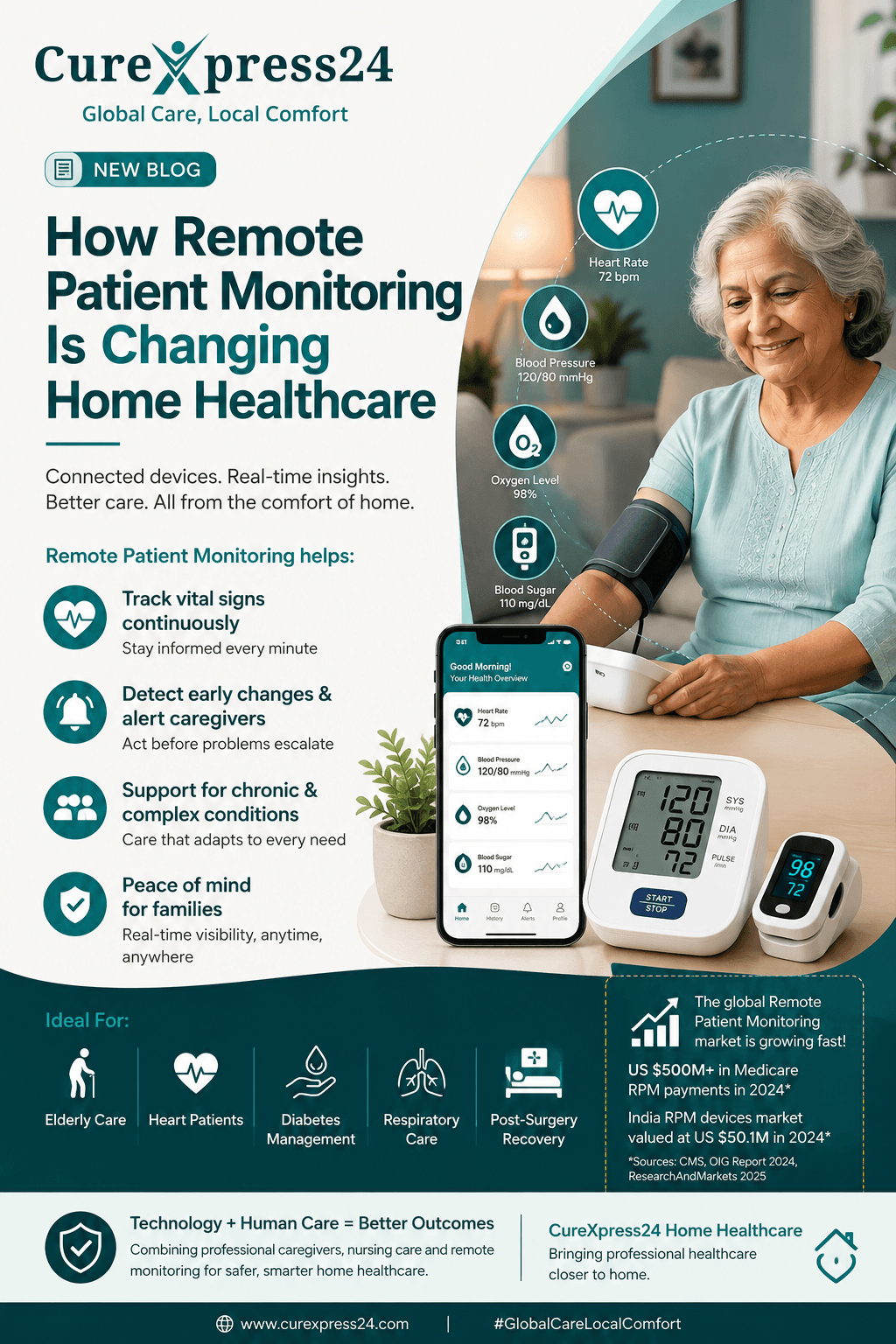
Remote patient monitoring uses connected medical devices to collect health information such as blood pressure, blood glucose, heart rate, oxygen saturation, weight, and temperature and transmit that information to healthcare professionals or care teams. Instead of relying only on occasional doctor visits, caregivers and clinicians can get a more continuous picture of a patient's health.
For home healthcare, this can be particularly valuable. Patients recovering after surgery, older adults, and people living with chronic conditions can receive closer monitoring without spending more time in hospitals or clinics.
Why Remote Patient Monitoring Matters in Home Healthcare
Healthcare is increasingly moving from a reactive model—treat the problem after it becomes serious—towards a more proactive model: identify changes early and respond sooner.
This is becoming increasingly important as populations age and chronic diseases become more common.
According to UNFPA, India had around 153 million people aged 60 and above, and that number is projected to reach approximately 347 million by 2050.
At the same time, chronic diseases require ongoing attention rather than one-time treatment. For example, diabetes, hypertension, heart disease, COPD and other long-term conditions may require patients to regularly monitor vital signs and follow treatment plans.
This creates a major opportunity for technology to extend healthcare beyond the hospital.
What Is Remote Patient Monitoring?
Remote Patient Monitoring is a healthcare model in which a patient uses a connected medical device to record health information at home.
The data can then be transmitted electronically to a healthcare provider or designated care team for review.
Common remote patient monitoring devices include:
Digital blood pressure monitors
Pulse oximeters
Glucose monitors
Digital weighing scales
Temperature monitors
Wearable heart-rate monitors
ECG-enabled devices
Other connected medical devices
For example, a patient with hypertension may use a connected blood pressure monitor at home. Instead of simply writing down the reading, the device can transmit the information electronically so that the care team can identify concerning changes and determine whether further action is needed.
In other words:
Device → Health Data → Monitoring → Alert/Review → Care Response
That creates a continuous connection between the patient's home and the healthcare team.
How Does Remote Patient Monitoring Work?
A typical RPM in healthcare system involves four basic steps.
1. The Patient Uses a Connected Device
The patient takes regular readings using an appropriate medical device.
For example:
Morning: Blood pressure + pulse
Afternoon: Oxygen saturation
Evening: Blood glucose or weight
The exact measurements depend on the patient's condition and care plan.
2. Data Is Transmitted Digitally
Instead of depending entirely on handwritten records, connected devices can transmit readings electronically.
This reduces the need for patients or family members to manually record every measurement.
3. The Care Team Reviews the Data
The information can be reviewed for abnormal readings, trends or changes from the patient's expected range.
Importantly, RPM is not simply about collecting large amounts of data. The value comes from turning that data into appropriate clinical or caregiving action.
4. Alerts Can Trigger Further Action
If a reading crosses a predefined threshold, the care team may be alerted.
Depending on the patient's care plan, this could lead to:
A caregiver checking on the patient
A nurse contacting the family
A teleconsultation
A doctor reviewing the patient's condition
A recommendation for an in-person assessment
Emergency medical attention when clinically appropriate
Remote monitoring therefore adds another layer between "everything seems fine" and "the patient needs urgent medical attention."
It does not replace doctors, nurses or emergency services. Instead, it can give them better information to support timely decisions.
Which Patients Can Benefit From Remote Patient Monitoring?
Remote patient monitoring can be particularly useful when a patient's condition requires regular observation.
1. Elderly Patients
Older adults may live alone or spend significant periods without a family member physically present.
Remote monitoring can provide families and professional caregivers with greater visibility into important health measurements.
This is especially relevant as India's elderly population continues to grow. UNFPA estimates that people aged 60+ could account for more than 20% of India's population by 2050.
2. Patients With Hypertension
Regular blood pressure monitoring can help identify patterns and changes that may otherwise go unnoticed between appointments.
3. Diabetes Patients
Depending on the clinical plan, connected glucose monitoring can help track blood sugar levels and support ongoing diabetes management.
4. Heart Disease Patients
Heart rate, blood pressure, weight and oxygen saturation may be relevant for selected cardiac patients, particularly when clinicians have prescribed ongoing monitoring.
5. COPD and Respiratory Patients
Pulse oximeters and other appropriate monitoring tools can help track oxygen saturation and other relevant measurements.
6. Post-Surgery Patients
The period after discharge can be particularly important.
A patient may appear stable when leaving the hospital but still require close observation during recovery.
Combining home nursing or caregiver support with appropriate remote monitoring can provide an additional layer of visibility during the recovery period.
Research into hospital-at-home models has found that remote vital-sign monitoring can contribute to safety, assessment and clinical decision-making.
The Biggest Advantage: Seeing Trends, Not Just Readings
One blood pressure reading tells you something.
A series of readings can tell you much more.
For example:
Monday: 128/82
Tuesday: 134/86
Wednesday: 142/90
Thursday: 151/94
A single reading might not provide enough context. A trend, however, may indicate that the patient's condition deserves closer attention.
This is where remote patient monitoring in home healthcare becomes powerful.
Instead of asking:
"How is the patient today?"
care teams can increasingly ask:
"How has the patient's health changed over the last several days?"
That shift from snapshots to trends can support more informed care decisions.
Remote Monitoring Can Also Give Families Peace of Mind
For many families, the biggest problem is not a lack of concern.
It is a lack of visibility.
A son working in another city may worry about his elderly parents. A daughter may call home several times a day to ask:
"Did you check your BP?"
"Did you take your medicine?"
"Are you feeling okay?"
Remote monitoring cannot replace human care, but it can provide another source of information.
When combined with professional home caregivers, nurses and patient attendants, technology can help families feel more connected to the patient's care journey.
Remote Patient Monitoring Is Growing
The adoption of remote monitoring is no longer limited to experimental healthcare programs.
In the United States, Medicare has covered remote patient monitoring since 2018, and the U.S. Department of Health and Human Services' Office of Inspector General reported that Medicare payments for RPM exceeded $500 million in 2024.
India is also seeing growth in the remote monitoring ecosystem. One 2025 industry profile estimated India's remote patient monitoring devices market at approximately US$50.1 million in 2024, with a 2019–2024 CAGR of 7.2%.
These numbers point towards a broader shift:
Healthcare is becoming increasingly connected, continuous and data-driven.
But Technology Alone Isn't Enough
Remote patient monitoring should not mean putting a device in someone's home and waiting for an alert.
The real value comes from combining:
Technology + Human Care + Clinical Oversight + Timely Response
There are also important limitations.
Not every patient needs continuous monitoring. Devices must be used correctly, readings must be reliable, patients need appropriate support, and abnormal readings need to be interpreted in the context of the individual's condition.
There are also important considerations around:
Data privacy
Cybersecurity
Device accuracy
Patient adherence
Internet connectivity
Alert fatigue
Clinical escalation
Integration with existing healthcare workflows
Therefore, RPM should be implemented as part of a structured care plan, rather than treated as a replacement for professional healthcare.
How CureXpress24 Can Help
At CureXpress24 Home Healthcare, we believe the future of home healthcare is not simply about sending a caregiver to a patient's home.
It is about creating a more connected care ecosystem where people, caregivers, nurses and technology work together.
For suitable patients, remote monitoring can complement our home healthcare services by helping create greater visibility into the patient's day-to-day condition.
For example, a care model can combine:
Patient at Home
↓
Connected Monitoring Devices
↓
Regular Vital Readings
↓
Caregiver/Nurse Observation
↓
Monitoring & Escalation
↓
Family Updates & Doctor Coordination
This approach can be particularly useful for elderly care, chronic disease management, post-surgery recovery and patients who require closer observation at home.
CureXpress24 can support families by combining professional home caregivers, patient attendants, nursing support and physiotherapy services with a technology-enabled approach to care, wherever remote monitoring is appropriate and available.
The goal is simple:
Don't wait for a health problem to become a crisis before you notice it.
With the right combination of technology and human care, families can have better visibility, caregivers can have better information, and patients can receive more continuous support—right from the comfort of home.
CureXpress24 — Bringing professional healthcare closer to home.
Key Takeaway
Remote Patient Monitoring is changing home healthcare from periodic observation to continuous, connected care.
For elderly patients, chronic disease management and post-hospital recovery, connected devices can provide valuable health information between doctor visits.
But technology works best when it is paired with people.
The future of home healthcare isn't technology replacing caregivers. It's technology helping caregivers care better.
Medical Disclaimer: Remote patient monitoring is not a substitute for emergency medical care, diagnosis or treatment by a qualified healthcare professional. The suitability of RPM devices and monitoring frequency should be determined according to the patient's condition and care plan.
Arrange care with clarity
Talk through what your family needs.
Get honest guidance, a written care plan, and a clear next step from the CureXpress24 team.
Book a free consultation