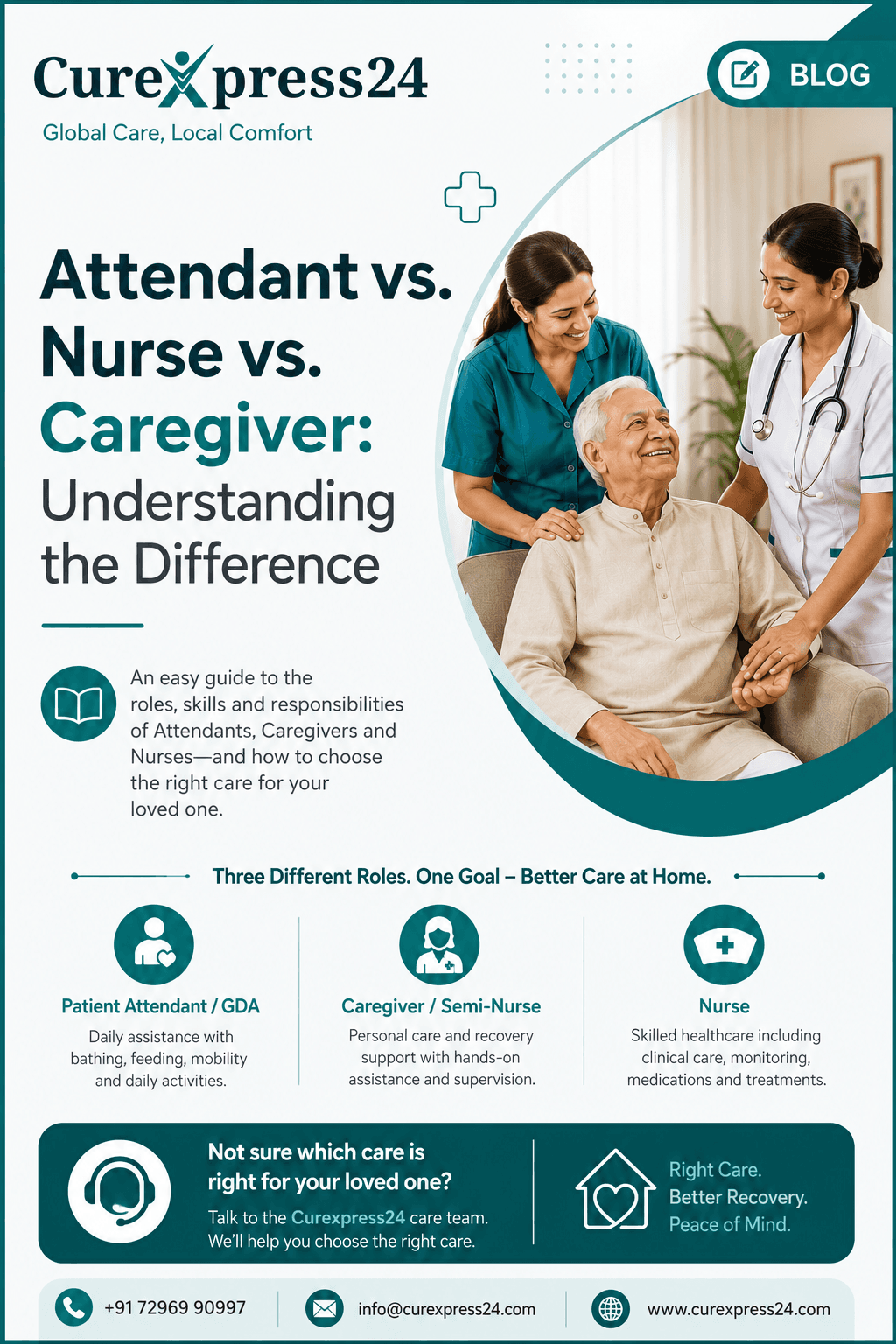
When a loved one needs support at home, one of the first questions families face is: “Should we hire an attendant, a caregiver, or a nurse?”
These terms are often used interchangeably, but they do not mean the same thing. Each role has a different level of training, responsibility, and scope of work.
Choosing the right professional is important because sending a person with more skills than necessary can increase costs, while sending someone without the required clinical skills can compromise the quality of care.
At CureXpress24, we help families understand these differences so they can choose the right level of home healthcare support for their loved one's condition and daily needs.
The Simple Difference
In simple terms:
Patient Attendant / GDA: Primarily supports daily activities, mobility, hygiene, feeding, companionship, and basic patient assistance.
Caregiver / Semi-Nurse: Provides more structured personal care and can support patients who need greater assistance with routine care and recovery, while working within their training and assigned responsibilities.
Nurse: A trained healthcare professional who can provide nursing care, monitor patients, administer medications and treatments within their scope, and handle more clinically demanding situations.
The right choice depends less on the patient's age and more on their medical condition, level of dependency, and the type of care they actually need.
1. What Is a Patient Attendant or GDA?
A Patient Attendant, often working at a GDA-level, is generally focused on helping a patient with everyday activities and providing physical support.
They are particularly useful when the patient is medically stable but cannot safely manage daily activities independently.
Common responsibilities include:
Helping with bathing and personal hygiene
Assisting with changing clothes and diapers
Helping with eating and drinking
Supporting mobility and walking
Helping the patient move from bed to chair
Providing companionship and supervision
Maintaining basic cleanliness around the patient
Accompanying patients to appointments when required
Reporting basic observations or concerns to the family or supervising healthcare professional
An attendant is not a substitute for a qualified nurse.
For example, if an elderly person is physically weak after an illness but does not require regular clinical procedures, a patient attendant may be an appropriate choice.
When is an attendant usually suitable?
An attendant may be suitable when the primary requirement is:
“Someone needs to be there to help my family member manage everyday activities safely.”
2. What Is a Caregiver or Semi-Nurse?
The term caregiver can cover a broad range of roles. In organized home healthcare, a caregiver or semi-nurse may have more training and responsibility than a basic attendant, depending on their qualifications and the service provider's defined scope.
They can be useful for patients who need regular personal care, closer supervision, and assistance throughout recovery, but do not necessarily require a qualified nurse around the clock.
Their responsibilities may include:
Personal hygiene and grooming
Bathing and toileting assistance
Feeding assistance
Mobility and transfer support
Positioning and basic pressure-area care
Assistance during recovery after hospitalization
Monitoring routine changes in the patient's condition
Supporting prescribed routines as directed
Companionship and emotional support
Communicating changes or concerns to the family or supervising healthcare professional
The exact responsibilities of a semi-nurse or caregiver should always depend on their actual training and competency, rather than simply the title used by an agency.
When might a caregiver or semi-nurse be appropriate?
Consider this level when the patient needs:
More hands-on support than a basic attendant, but does not require continuous skilled nursing care.
For example, a patient recovering from surgery may need help with mobility, bathing, feeding, toileting, and daily routines while the family manages the medical instructions provided by the doctor.
3. What Is a Nurse?
A nurse is a trained healthcare professional with formal nursing education and clinical responsibilities.
Depending on their qualifications, experience, and the patient's care plan, nurses can provide a significantly higher level of clinical support than an attendant or general caregiver.
Their responsibilities may include:
Monitoring vital signs
Administering medications as prescribed and within their scope of practice
Wound and dressing care
Catheter-related care
Injections when appropriately prescribed and permitted
Clinical observation and documentation
Supporting patients with complex medical needs
Post-operative nursing care
Supporting patients requiring specialized nursing attention
Recognizing changes in a patient's condition and escalating concerns appropriately
Coordinating with doctors and the family regarding the patient's care
For patients with significant medical needs, the presence of a qualified nurse can be essential.
When is a nurse usually appropriate?
A nurse should be considered when the patient requires:
Clinical monitoring, nursing procedures, medication-related support, or care that goes beyond routine personal assistance.
Attendant vs. Caregiver vs. Nurse: At a Glance
Attendant vs. Caregiver vs. Nurse: At a Glance
Patient Attendant / GDA
A patient attendant primarily provides daily assistance and non-clinical support. They can help with bathing, hygiene, feeding, mobility, changing clothes or diapers, companionship, and basic supervision. They are generally suitable for medically stable patients who mainly need help with everyday activities.
Caregiver / Semi-Nurse
A caregiver or semi-nurse provides more hands-on personal care and recovery support than a basic attendant. Depending on their training, they may assist with personal care, mobility, positioning, feeding, supervision, and routine recovery support. Their responsibilities should always remain within their actual training and assigned scope.
Qualified Nurse
A qualified nurse provides skilled nursing and clinical support. Depending on their qualification and scope of practice, this may include monitoring vital signs, medication-related care, wound care, catheter care, injections, clinical observation, and other nursing interventions. Nurses are generally appropriate when a patient's needs go beyond routine personal assistance.
In simple terms:
If the patient mainly needs help with daily activities, an Attendant/GDA may be appropriate. If they need more intensive personal and recovery support, a Caregiver/Semi-Nurse may be suitable. If they require clinical monitoring or skilled nursing care, a Qualified Nurse is the better choice.
The important thing is not to choose based only on the title. Choose the professional based on the patient's actual condition, dependency level, and care requirements.
Important: Job titles can vary between agencies. Always ask about the person's actual qualification, training, experience, and responsibilities before assigning them to a patient.
The Skill Hierarchy: Who Should You Choose?
A useful way to think about home healthcare is:
GDA / Patient Attendant → Caregiver / Semi-Nurse → Qualified Nurse
As you move up this hierarchy, the level of training and clinical responsibility generally increases.
But “higher qualification” does not automatically mean “better choice.”
If your father only needs help walking, bathing, eating, and getting in and out of bed, hiring a nurse may not be necessary.
Similarly, if your mother has a complex medical condition requiring clinical monitoring and nursing procedures, an attendant may not be appropriate.
The goal is to match the right professional to the patient's actual needs.
Real-Life Examples
Example 1: Elderly person living alone
An 80-year-old is medically stable but has difficulty walking, bathing, eating, and managing daily activities.
Likely requirement: Patient Attendant / GDA
The main need is assistance and supervision rather than continuous clinical nursing.
Example 2: Patient recovering after surgery
A patient has returned home after surgery and needs help with bathing, toileting, mobility, feeding, positioning, and following a structured recovery routine.
Likely requirement: Caregiver / Semi-Nurse or Patient Attendant, depending on the patient's condition and care plan.
If clinical procedures or skilled nursing interventions are also required, a nurse may be needed.
Example 3: Patient requiring clinical care
A patient requires regular vital monitoring, wound care, medication administration, catheter care, injections, or other nursing interventions.
Likely requirement: Qualified Nurse
An attendant may still be useful for additional daily assistance, but the clinical component requires an appropriately qualified professional.
What About Having Both an Attendant and a Nurse?
Sometimes, one person cannot realistically meet every care requirement.
For example, a patient may need:
A nurse for clinical care
An attendant for mobility, hygiene, feeding, and companionship
In such situations, combining professionals can provide better coverage.
This can also prevent a nurse from spending most of their shift performing tasks that do not require nursing expertise.
The right combination depends on the patient's condition, dependency level, doctor's instructions, and family requirements.
6 Questions to Ask Before Hiring Home Care Staff
Before choosing a caregiver, attendant, or nurse, ask:
1. What exactly does the patient need help with?
Make a list of daily and medical requirements instead of simply saying, “We need a caregiver.”
2. Does the patient require clinical procedures?
If yes, determine whether those procedures require a qualified nurse.
3. Is the patient medically stable?
A medically stable patient with mobility difficulties may need very different support from a medically complex patient.
4. What is the professional's actual qualification?
Do not rely only on titles such as “caregiver,” “semi-nurse,” or “attendant.”
Ask about their training and experience.
5. How much supervision does the patient require?
Someone who needs occasional assistance is different from someone who needs continuous supervision.
6. What happens if the patient's condition changes?
A reliable home healthcare provider should have a clear escalation and replacement process when the patient's needs change.
How to Choose the Right Professional
A simple decision framework is:
Choose a Patient Attendant / GDA if:
The patient is medically stable
The primary need is daily assistance
Mobility support is required
Help with bathing, feeding, toileting, or changing is required
Companionship and supervision are important
Consider a Caregiver / Semi-Nurse if:
The patient requires more hands-on personal care
The patient is recovering from illness or hospitalization
Regular assistance and closer supervision are required
The patient has greater dependency but does not require continuous skilled nursing
The person's training matches the required care tasks
Choose a Nurse if:
Clinical monitoring is required
Nursing procedures are required
Medication administration or other skilled interventions are part of the care plan
The patient has complex medical needs
The doctor or healthcare team recommends skilled nursing care
When in doubt:
Don't choose based on the job title alone. Choose based on the patient's actual care requirements.
A professional assessment can help determine whether you need a GDA/attendant, caregiver/semi-nurse, nurse, or a combination of professionals.
Why Choosing the Right Level of Care Matters
Home healthcare is not simply about having “someone at home.”
It is about having the right person doing the right job.
The wrong level of care can create two problems:
Under-qualified support: The patient may not receive the care they actually need.
Over-qualified support: Families may pay for professional nursing services when the patient's needs could be safely managed with a trained attendant or caregiver.
A good home healthcare service should therefore begin with understanding the patient's condition and requirements before recommending a professional.
Need Help Choosing Between an Attendant, Caregiver or Nurse?
If you're unsure which type of home healthcare professional your loved one needs, you don't have to make the decision based on a job title.
CureXpress24 can help you understand the level of care required and connect you with the appropriate home healthcare professional based on the patient's needs.
Whether you need a Patient Attendant/GDA, Caregiver/Semi-Nurse, Qualified Nurse, Physiotherapist, or Doctor Home Visit, the first step is understanding what kind of support the patient actually requires.
Not sure where to start? Talk to the CureXpress24 care team and let us help you choose the right level of care.
Frequently Asked Questions
Is a caregiver the same as a nurse?
No. A caregiver primarily provides personal and daily living assistance, while a qualified nurse has formal nursing education and can perform skilled nursing responsibilities within their scope of practice.
Is a patient attendant a nurse?
No. A patient attendant or GDA primarily provides daily assistance and patient support. They should not be assigned nursing procedures that require a qualified nurse.
Is a semi-nurse a qualified nurse?
Not necessarily. The term “semi-nurse” can be used differently by different providers. Families should always verify the person's actual qualification, training, and scope of responsibilities.
Can an attendant give medicines?
Medication-related responsibilities should be handled according to the individual's training, the care plan, and applicable professional requirements. Families should not assume that an attendant has the same medication-related authority or training as a qualified nurse.
Does an elderly person always need a nurse?
No. Many elderly people need assistance with daily activities but do not require continuous skilled nursing. An appropriately trained attendant or caregiver may be sufficient depending on their condition.
Can a patient have both a nurse and an attendant?
Yes. In some cases, combining skilled nursing with daily assistance is the most appropriate arrangement.
How do I know which one my family member needs?
Start by listing the patient's medical requirements, daily activities they cannot perform independently, mobility limitations, and any procedures or monitoring required. A professional home healthcare assessment can then help determine the appropriate level of support.
Arrange care with clarity
Talk through what your family needs.
Get honest guidance, a written care plan, and a clear next step from the CureXpress24 team.
Book a free consultation